Key Challenges in Safeguarding for International Schools: An Overview of the Literature

School safeguarding, within the context of international schools, encompasses a broad range of practices and concerns aimed at protecting children’s health, well-being, and human rights. Initially, the focus of safeguarding in these settings was primarily on preventing sexual abuse by educators through measures like safer recruitment and criminal background checks. However, this understanding has significantly broadened over time to include other forms of harm and comprehensive well-being. The evolving scope of safeguarding in international schools now covers:

• Harm between children (peer-on-peer abuse)
• Affluent neglect
• Online harm such as bullying, sexual harassment and exploitation
• Identity-based harm such as racism, Islamaphobia or homophobia
• Student mental health and well-being, including issues like suicidal ideation and self-harm
• The impact of transition on well-being for internationally mobile students (Third Culture Kids or TCKs)
•Fostering a sense of belonging and respectful, trusting relationships within the school community.

This broadened approach also recognizes the interlinkage with data protection and the need for whole-school strategies.

Challenges to Safeguarding in International Schools

International schools, despite often having significant resources, face unique and complex challenges in implementing effective safeguarding practices due to their diverse populations, mobile nature, and varied legal and cultural contexts.

Affluent Neglect:
This is a particularly challenging area, as affluent families are often perceived as “low risk”. However, children in these families can experience severe emotional neglect due to parental isolation, excessive pressures for achievement, and a focus on material provision over emotional needs. This neglect is often masked because physical needs are met. Independent boarding schools may struggle to identify these children as being “in need or at risk of significant harm, and designated safeguarding leads (DSLs) can be reluctant to raise concerns due to parents’ transactional arrangements with schools or their power and influence.

Peer-on-Peer Abuse:
There is limited academic research specifically on peer-on-peer abuse in international schools. Forms of harm include cliques, gossip, anti-snitching cultures, sexual harassment and assault, peer pressure, social exclusion, physical assault, and specific issues related to nationality hierarchies or geopolitical tensions. Addressing harm that occurs outside school premises, including online, is complex and unclear, with many schools lacking adequate policies or legal clarity on their intervention scope.

Cultural and Legal Barriers:
International schools operate across 159 countries with diverse cultural and legal contexts. Conflicting cultural norms around discipline (e.g., physical punishment), care-giving, sexuality, and reporting can cause confusion and undermine safeguarding efforts. Some laws criminalize behaviors like certain sexualities or mental health issues, increasing student vulnerability and schools’ reluctance to report.

Relationship with External Agencies:
Many international schools are isolated from their surrounding communities and local agencies, operating in a “grey legal and political area. There can be a lack of trust and cooperation with local law enforcement and child protection services, with some agencies perceived as ineffective, corrupt, or even potentially causing greater harm to the child if abuse is reported. This leads schools to manage issues internally or rely on embassies and NGOs instead of statutory services.

Parental Power and Influence:
Affluent and influential parents can exert considerable pressure on international schools, sometimes undermining investigations or demanding specific outcomes to protect their family’s reputation or status.

Transitions and Staff Turnover:
Frequent student mobility (TCKs) and high staff turnover can hinder the development of trusting relationships and effective information sharing, making it difficult to identify patterns of harm or transfer safeguarding concerns between schools.

Application of Western Models:
Many international schools apply child protection models that originate from Western countries (e.g., UK, US, Australia), which may not align with local cultural and legal contexts. This can lead to resistance from local parents and professionals, perceived as a “western imposition,” and may be less effective than culturally contextualized approaches.

Safeguarding Practices and Enablers

Despite these challenges, international schools employ various strategies and leverage specific roles to support safeguarding:

Role of Counsellors and DSLs:
School counselors are identified as key personnel for supporting students’ unique developmental and mental health needs, particularly TCKs. They are often seen as trusted adults and play a critical role in developing and delivering student education and transition support. However, clarity on the division of roles and collaboration between counselors and Designated Safeguarding Leads (DSLs) is important. DSLs are responsible for overseeing safeguarding, and strong leadership by principals and DSLs who prioritize safeguarding and empower staff is a powerful positive force.

Policies and Procedures:
Clear, written safeguarding policies and procedures are crucial. Centralized, digital record-keeping systems for safeguarding concerns help identify patterns and intervene early.

Student Voice and Education:
Involving students in co-constructing safeguarding strategies and providing education on topics like consent, healthy relationships, and online safety is vital. However, time and resource constraints can be barriers to effective curriculum delivery.

Team Approach:
A team approach to managing safeguarding concerns, involving multiple professionals, is valued as it shares the burden and strengthens practices. Regular multi-disciplinary meetings help discuss student concerns.

Networks and External Support:
Engaging with local networks of international schools, international accrediting bodies (like CIS), training providers, and other external organizations provides valuable guidance, support, and external validation. Building relationships with individuals in local law enforcement, child protection agencies, and community-based NGOs can also strengthen practices

Culturally Responsive Strategies:
Developing strategies to work in partnership with families on sensitive issues, such as physical discipline in the home, by aligning with school values and educating parents can be effective15221. The need for cultural matching and contextualization of safeguarding approaches is particularly strong when Western professionals serve non-Western communities19….

In conclusion, school safeguarding in international schools is a complex and evolving field, moving beyond traditional concerns to encompass a holistic view of child well-being. While progress has been made in establishing foundational practices, significant challenges persist, particularly related to the unique cultural, legal, and social dynamics of globally mobile communities and the influence of affluent families. Addressing these challenges requires culturally informed, collaborative, and adaptable approaches, along with continued research to understand the diverse experiences of students and optimize safeguarding interventions.

Should I Stay or Should I Go? Making Contractual Decisions

It is that time of year again – people are starting to make decisions about whether they are staying or leaving their international school contracts. It can be really tough to make a decision, especially when you don’t have a job already lined up. So, if you are in the cycle this year, here are some things you may want to consider:

Your Current Job:

  • On a scale of 1 to 10 – how much do you enjoy work when you are there?
  • How well do you get along with your collegues and direct line management?
  • How much autonomy and control do you have?
  • Is your workload manageable?
  • Do you like your students overall?
  • Do you feel like you are being challenged enough?
  • Do you feel valued at work?
  • Do you like going into work most days?
  • Are the pay and conditions good?
  • Do you have enough resources to do your job effectively?
  • How is your working environment?

Your Career (If this is important to you)

  • Are there opportunities to progress in your current school?
  • Are there opportunities for you to have more control over your work in your current role?
  • Are there opportunities for a pay rise in your current position?
  • Would you like to work for a higher tier, or a better known school?

Your Family

  • If you are currently with a partner and/or children – are they happy where you are?
  • If applicable, is there better opportunities for work for your partner elsewhere?
  • If applicable, where are your children in their education? Will you get stuck if you stay?
  • If you don’t currently have a partner and/or children, do you see a future for this where you are?
  • Are there issues with family members back home that mean you would like to be closer?
  • Are there any physical or mental health needs that would be better treated elsewhere?

Your Work/Life Balance

  • Do you feel you have a life outside of your work?
  • Are there opportunities for fun or hobbies where you live?
  • Do you “gel” with your current country, or would you be more suited elsewhere?
  • What do you like and dislike about your current country?
  • Do you have the energy to have a life outside of work, or is this job burning you out?
  • Do you only stay because of the money?

Making a decision this early in the school year can be really hard, and if you would like some impartial support to make your decision, I am offering a limited number of 3 solution-focused coaching sessions for the reduced price of ฿‎7000. Book yours below:

Go back

Your message has been sent

Warning
Warning
Warning
Warning!

The Cycle of Self Esteem

Many years ago I worked as a Sex & Relationships Outreach worker for a small team based within the NHS called Teenage Kicks. We did 3 sessions as a staple offer. One on self esteem and rights, one on relationships and one on contraception. I’m unsure where this exercise came from (my guess is probably something from Jo Adams) but it has been one that has created so many AHA! moments for both young people and adults, not only in terms of self esteem but also in recognising that we are not mind readers and cannot always tell why someone is behaving the way they are.

This is how I use the Cycle of Self Esteem (though sometimes I don’t call it anything):

Getting young people to understand not everything is about them:
One day I was talking with 2 young people at war. Previously the best of friends, each swore blind that the other had stopped speaking to them first. Turns out, Person A had went to talk to Person B between classes, and Person B had walked off and ignored them. Person A then believing Person B had stopped speaking to them avoided them and effectively stopped talking to them. Person B had no idea what happened. They were so caught up in worrying about a test they had the next period that they hadn’t noticed Person A trying to talk to them, all they knew is that their best friend stopped talking to them seemingly without reason. So they didn’t talk to them either. What they both thought “they’re not talking to me, what did I do wrong?” caused them both to avoid the other person. They laughed when they realised what had happened. I use this example often when people get stuck in the “its their fault”

Changing our thoughts & behaviour to support peers
Along the same lines, within Psychological First Aid Training for Students I ask young people to write down all of the things that someone might be thinking or feeling when they are having a bad day, We often get ideas such as feeling upset, or angry, thinking no-one likes them, or that the world is unfair. Then I ask them to consider how this may impact their behaviour – examples are usually things like withdrawing, not talking to people, acting moody or snapping at people. How might others think/feel about them? And how will that impact their behaviour? The reflection here for young people, especially those who are being trained to provide peer support, is to understand that how people behave is rarely about those around them, it’s about them. So if our first reaction is to believe it’s about us, we will often withdraw as well which may further impact how bad the person is feeling. If our thoughts are “they’re clearly having a bad day” we are more likely to ask if they are okay and what they need (which may be to be left alone which is fine). It also seperates us from feeling automatically responsible for someone elses behaviour and helps them to take responsibility for feeling better.

Helps young people to think about coping strategies & ways to change mood
We all have bad days, heck sometimes even bad years, and sometimes our behaviour can be less than pleasant. It is important to stress that no matter how we feel we are always responsible for our own behaviour. Understanding what we need when we are feeling down to help us feel better or to recharge, and verbalising that to friends and family is really important. If you know that you get really angry and want to argue and fight with people when you’re stressed out, perhaps trying a different strategy like taking a really cold shower or venting it all out on paper is better. And be upfront about it – tell people that this is how you feel and what you need to do to feel better. Have those conversations, otherwise people may think your mood and behaviour is all about them.

Humans are social creatures and we often make assumptions about people based upon how they behave. As a side note I’ve found that explaining that a child has, for example, ASD or ADHD, can dramatically alter other people’s perceptions of them in a positive way, as they no longer think of their behaviour as defiant or trouble-making. The belief that a child is doing a certain thing just to annoy you, as opposed to they can’t help their behaviour is a seisemic shift when it comes to how we behave towards them, and how they in turn feel about themselves.

Is this something you think could be useful in your work with young people? Or is this something you already use? Let me know in the comments

How much is too much stress?

While a little bit of stress may be good for us to get working well, too much and we’re tipping into anxiety, panic then burnout. Too much stress and we lose motivation, it’s more difficult to concentrate and to remember things.
Sometimes when we’re stressedout we keep jabbing at the thing we’re trying to do. We get frustrated and angry, and we can’t get anything done properly.

At this point you need to

STOP.

Breathe.

Go do something else for a time. Then come back to it. If it’s your life overall that is stressful, try to find some time in your day where you can do something mindful or fun. This helps reduce your stress levels, and allow your brain to start processing properly. When I tell students this they sometimes say

“I don’t have time!!!”

But you do. Because by taking time out here and there and giving your brain some recovery time. You’ll actually be able to think more clearly, work will become easier and you’ll increase your memory and concentration.

For example, did you know that just 1 hour of gardening each week has been shown to reduce anxiety? Just this small amount of time each week can have amazing benefits.

What mindful activities do you do to relieve stress?

Third Culture Kids

A Third Culture Kid or TCK for short is a young person who has lived for a significant amount of time outside of their parents home country. Sometimes called Transnational Kids or Cross Cultural Kids, their personal identity will be different from both that of their parents and the cultures in which they live. They become a hybrid of the two; hence the term “third culture”.

There are approximately 600 million people worldwide who live outside of their birth country for various reasons; some families only live in countries for a set period of time (e.g. diplomatic staff, military families, those who work for some international corporations), others move out of necessity (displacement due to war etc) and others permanently migrate to another country.

The diagram above can help people understand how they are different and similar to both their parents and the wider culture. They can use the structure to figure out what aspects of their identity come from where, and what they also find difficult. For example some young people lose the ability to speak their parents home language so can find it difficult to converse with grandparents.

How about you? Are you a TCK? What have you found to be the difficulties and the strengths you’ve gained from living away from your parents passport country?

Self Care Planning

20200215_101258_0000

The idea that we need to care for ourselves is not new but many of us still neglect it. Why? I think it’s because when times are good, like our physical health, we don’t take much notice of our mental and emotional health. We just potter on.

On the flipside some of us roll our eyes at the idea of self care while actually practising it. Self Care doesn’t have to mean sitting meditating every day, for example it doesn’t do it for me, but exercise where I can immersed in the moment does. For some spiritual self care will be about prayer, for others walking in the woods with their dogs will rejuvenate their spirit.

It also depends on how you are doing overall. If your emotional weather is generally sunny at the moment, self care is putting routines in place that can help you when your storms come. If you’re in the midst of a mental health crisis your self care routine may be as simple as focusing on ensuring you have eaten & had a shower. Something which isn’t as simple as it sounds when you are not doing okay.

Your support system is also really important to acknowledge – who can you turn to if the going gets tough, or to have fun with this week? Your support system doesn’t have to be IRL it could be friends online, helpline numbers or support services. There is always support out there, no matter how alone you feel.

So choose to take some small steps today to invest in your emotional wellbeing – it would be great to hear how you look after yourself in the comments!

Putting Condoms on in the Dark: How to make a furry box

I used to do sexual health outreach sessions in the city centre, and there is always problems with doing any kind of condom demonstration out on the streets as, well, you don’t want to be brandishing, what to many members of the public anyway, looks like a plastic penis…

Soooo I’ve made a ‘furry box’ – this has the advantage of not only being ‘discreet’ but it also helps young people practice putting condoms on in the dark.

They are also fairly cheap and easy to make. Before you start you will need:

1. A box with a lid – I use a photocopy paper box
2. Some outlandish fake fur
3. Scissors
4. Glue and/or staples

Okay-cokey – Ready? Lets Go…

Step One
Remove the lid and cut 2 holes in either side of the box so when the lid goes back on you can stick your hands through comfortably as shown below:

Step 2: Cover the lid with fur using either the glue or the staples to hold it in place.

Step 3: Cover the base with fur as above

And TA-DA! You should have something which resembles the one below.

Step 4
Stick a condom demonstrator in it and a load of condoms and challenge young people to see if they can put a condom on in the dark.

How does your behaviour affect your relationships?

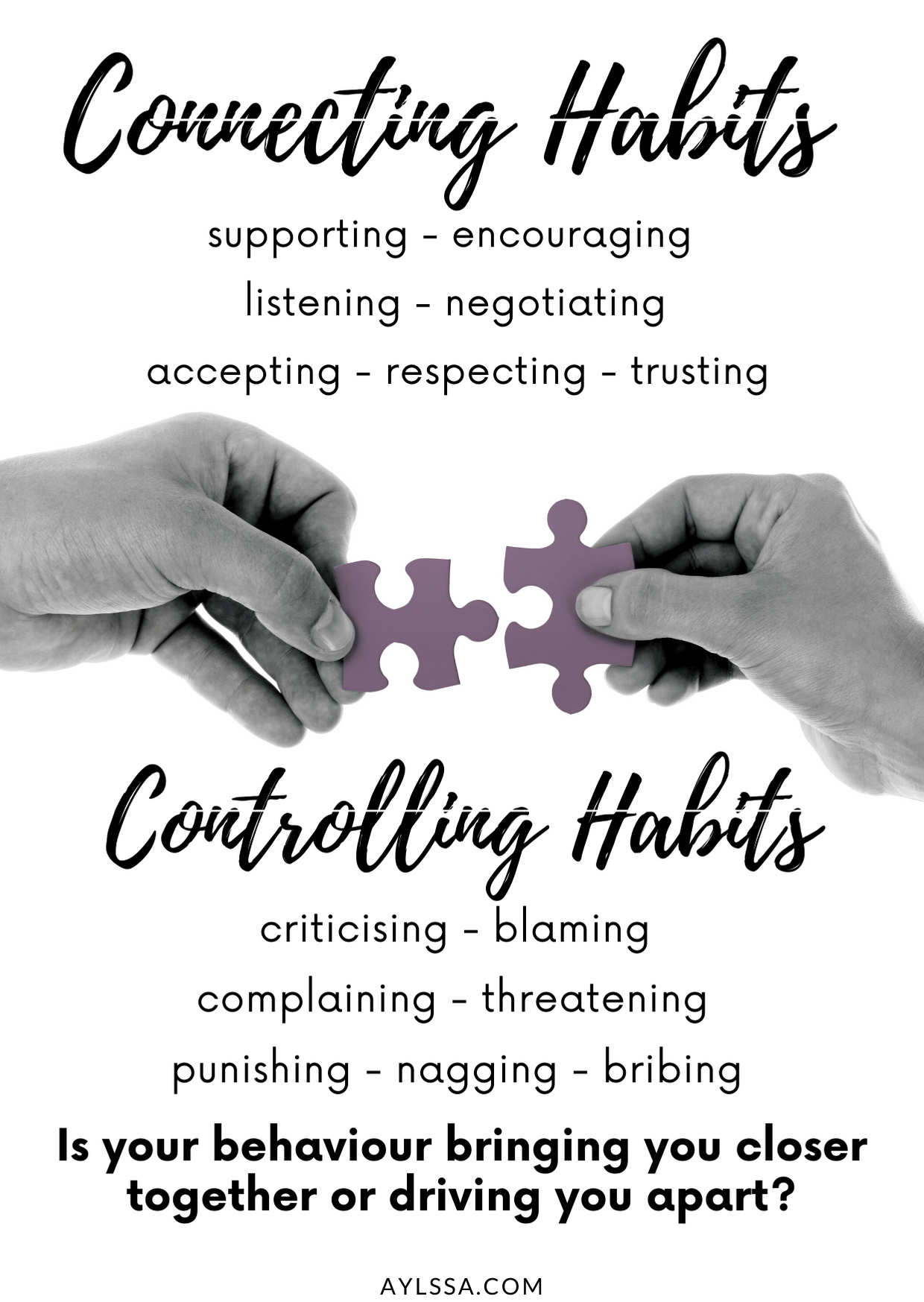
One of the main issues I work with as a counsellor is relationships and how people can become closer to the ones they love. Often they have gotten into patterns of controlling behaviour and seem to think if only the other person could change their behaviour then they would be happy. But relationships are not one sided and no-one has a magic control wand that makes other people do what they want them to do. So just as no-one can control you, you can’t control anyone else. The only persons behaviour you can control is your own. That is not to say people don’t try to – they will bribe, threaten, nag, criticise and punish to attempt to get people to do what they want. This doesn’t bring people together though, it tends to pull them apart. I may be going out on a limb here but I’m pretty certain you don’t like anyone trying to control you.

William Glasser in Choice Theory talks about 7 Deadly Habits: deadly because they are likely to kill any relationship, whether that be romantic or friendship. He also talks about 7 Caring or Connecting Habits which will bring people closer together. Both are below:

Controlling Habits.png

People are often quick to tell you what the other person has done, or not done. They get frustrated and possibly angered at the other person. Reminding them that the only behaviour they can control is their own, I always ask:

  • What do you want from your relationship? Do you want to stay together?
  • What are the main problems in your relationship?
  • What are you doing that are sustaining these problems?
  • What is going well in your relationship?
  • What is one thing this week you could do in terms of your behaviour that will bring you closer to the relationship you want?

Most people can think of at least one thing they can do. It could be as simple as eating together without playing on their phone, or asking how their day was. If you are in a rut with your relationship, give these a go. Reflect and make a small change today.

Show up… but also look after you.

I finally finished watching the third season of 13 Reasons Why and I wanted to pick up something the (new) school counsellor says to Clay Jenkins.

He asks “how do you do your job everyday when nothing ever changes?”

She replies by telling him that he personally helped Tyler change by encouraging him to seek help. She says all she does is show up. Good days. Bad days. She shows up, implying that’s all most people need. Someone reliable they can talk to when things are tough. That and I believe someone who hangs onto the hope that things can and do change for people. That things can get better.

In the show Clay is that person. He is the keeper of secrets, the friend most people turn to when there is a crisis. He shows up. And you can see the weight of what he carries around.

You can also see that without all that weight he would be lighter, happier.

I’m not arguing that you should stop listening to your friends. I am arguing however that if you are a “Clay Jenkins” please speak to someone to offload, maybe someone like me, a school counsellor. You don’t need to tell us your friends secrets, just how you are doing so you don’t take on too much. Counsellors have Supervision to help them deal with everything they hear – use us to help you deal with what you do.