I opened one of my uni notebooks yesterday and chuckled loudly. In November last year, a couple of months into my doctoral program, I had come across a narrative exercise which asks you to think about your life in terms of chapters and what they would be called. I found it quite a fun thing to do, and it helps you narrate your life on your terms. You could do it for any big events in your life – parenting, relationships, studying, career changes or even just naming the year you’ve had. In particular, this exercise was looking at jobs – this is what I wrote:
Age
Job
Chapter Title
16
Pub DJ (it was the 90s…)
Play David Essex for me…
17
Telesales
Hidin’ in the Booth
18-20
Customer Service Operator
The Toilet Button and Other Tales of Woe
21 – 24
Detached Youth Worker
Wandering the Streets
22 – 26
Drop-in Worker
Condoms, Chlamydia & Conservative Christians
27-30
Charity Management
I really like Spreadsheets, no really I do
30 – 31
Charity Management
Life on a Dot in the Middle of the Ocean
31 – 32
Sexual health outreach worker
Trundling with the Trolley
33 – 42
International School Counsellor
Repeat after me: Thoughts are not Facts!
42 – 44
Business Owner
Stop trying to kill me, Thailand…
I had to chuckle after the last one. I had no idea that this year I would survive ovarian cancer while still here in Thailand. Maybe I jinxed myself by calling this chapter that!
Do you think this could be an interesting exercise for you to do? Let me know how it goes, and I wish you call a lovely 2015.
When you think about ADHD – what springs to mind? For many people a white boy bouncing off the walls in a classroom is what they think of. We don’t often think of the chatty girl in the corner, or the one who spends her life seemingly daydreaming or can’t find the words she wants to say. Like with Autism, girls are more likely to be misdiagnosed with anxiety or depressive disorders than as neurodivergent.
I’ve had many a conversation over the years with professionals and parents who don’t think a diagnosis is necessary because they don’t want a child ‘labelled’.
Put yourself in the child’s position: What happens when you don’t understand why you are being rejected by your peers because you are ‘too much’ or can’t remember birthdays or do those lovely friendship maintainance things? What happens when you spin into anxiety because you can’t remember to pack the things you need for school and the teachers spend a lot of time telling you off? How do you comprehend the deep physical pain you feel when trapped in a boring classroom listening to an uninteresting teacher? How do you understand that sometimes you can do a lot of work, but other times you cannot muster any energy to pick up a pen? How do you feel when you get told off for the zillionth time for being late, or making too much noise, or zoning out…
What if you label yourself as stupid or lazy, instead of neurodivergent?
ADHD is more than just school – we know now it is lifelong, and not episodic. The idea that people will ‘just grow out of it’ has been shown not to be the case for the majority of people. Things may become easier for some people when they have the right coping strategies, or perhaps they have learnt to mask away their symptoms, but this does not mean they are ‘fixed’.
ADHDers can sometimes get themselves through school because they have the supports, but fall apart at university, or when they start relationships or have the extra pressures of having a family. The coping strategies and behavioural modifications that have worked so well in the past don’t work as well as they did and they can fall apart. Getting them to the end of school is not the end-goal. We need to start taking it a little more seriously – did you know, for example, that people with untreated or undiagnosed ADHD on average live 10 years less? We have a higher risk of:
teen pregnancy & STIs
intimate partner violence
disordered eating
substance abuse
suicide attempts and self injury
depression and anxiety, including post-partum depression and anxiety
PMDD and PPD
relationship & friendship problems
accidental death (such as car accidents)
diabetes and heart problems.
It is believed that around 5% of the population has ADHD and as Ari Tuckman famously says, ADHD rarely travels alone. It can be really serious for people without the right diagnosis and support. I meet many adults in my counselling practice who have struggled for many years when all along the underlying cause was ADHD. If you need some help please reach out.
The one thing that connects all humans in their need for a “good life” is connection. Each of us, no matter who we are need to believe that at least one person, somewhere, cares about us.
Ever wondered why some people who seem to have it all, are miserable? It’s lack of true connection, once they are rich / famous, they may start to doubt that they have true friends. A similar thing happens with “affluent neglect” – those kids that have everything that money can buy but their parents are absent or emotionally unavailable as they spend all of their time working.
Connection and friendship/love are protective factors against a whole host of mental health issues. When people feel disconnected and lonely they are more at risk of serious mental health problems. This is why one of the highest suicide rates are amongst the elderly – everyone they’ve loved has already gone. When people feel connected to someone, they are more likely to overcome lifes challenges. Every time I hear a story of someone managing to live a great life after a childhood full of abuse, there is always someone that they connected with, that showed them compassion and care – often a teacher, but it could be anyone within the community.
So find your person, or your tribe. Phone a friend you haven’t spoken to in a while. Join a sports club or do something that gets you out and about to meet people. Hold close the people you care about. Smile at random strangers, talk to people on public transport, laugh with your co-workers – you will never truly know the positive impact you have on them and they may need it more than you do.
Whats it about? Ellen Forney is a graphic artist with Bipolar Disorder. Her graphic memoir “Marbles” charts her unravelling into mania then her journey towards diagnosis and treatment, while this one is all about how to cope when your mental health isn’t great.
Why do I love it? Firstly it is a graphic novel aka comic so it is super easy to read and follow. It is also packed with great advice and explanations of the different kinds of therapies, how to pick the best therapy for you and how to cope in a mental health crisis. Although it is aimed at people with bipolar disorder, the advice within it is helpful to most people, and as a counsellor I teach many of the coping strategies outlined in this book.
F*ck Feelings by Michael I. Bennett MD & Sarah Bennett
What’s it about? The subtitle of the book is “One shrink’s practical advice to managing all life’s impossible problems” and that’s exactly what it is – covering everything from annoying family members, to wanting to make everyone feel better, to heartbreak and everything inbetween. And despite the title, they actually care about feelings a lot but recognise you can’t always get what you want – so will give you realistic alternatives to stop you being miserable.
Why do I love it? I adore the structure of this book which is basically – 1. Here’s what you wish for but can’t have 2. Here’s what you can aim for and actually achieve 3. Here’s how you do it. It is super practical, realistic and actually quite funny.
I also find that people can be miserable because they want people to change or for things to be different in ways that they can’t, and this book aims straight for that. Caution though – as the title would suggest – it is full of swears.
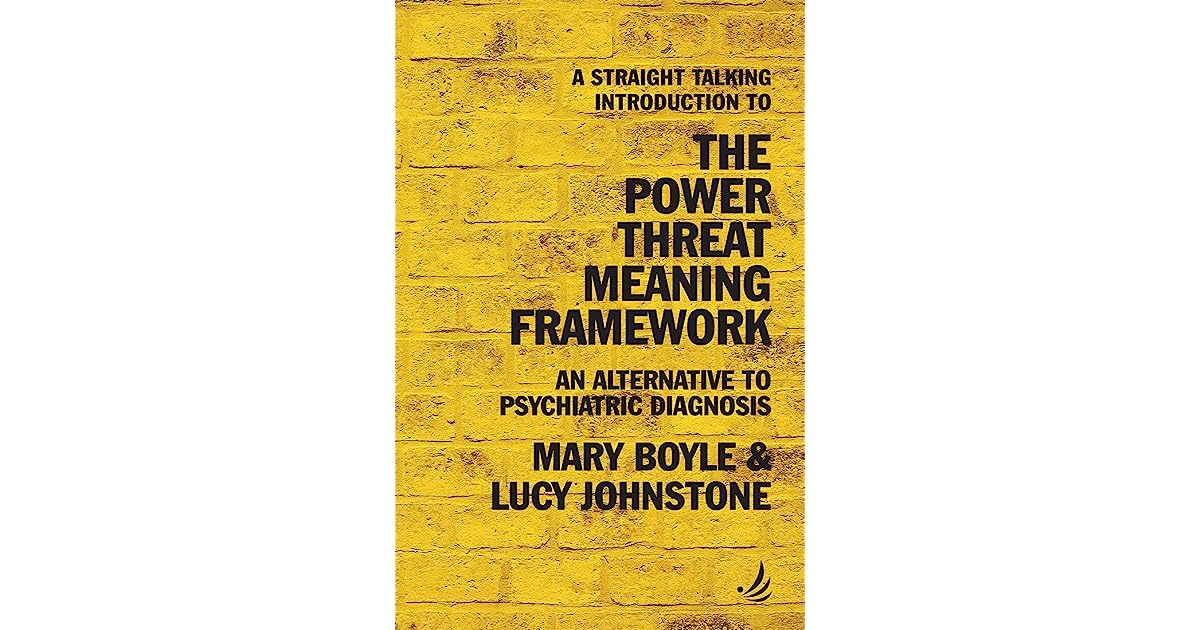
“A Straight Talking Introduction to the Power Threat Meaning Framework – An Alternative to Psychiatric Diagnosis” by Mary Boyle & Lucy Johnson
What’s it about? While not a self-help book in the traditional sense, I think this could be very helpful to a lot of people who are struggling to understand why they feel the way that they do. As it states on the title, this is the alternative to the medical model of mental illness – so instead of seeing mental ill health as a series of diagnostic symptoms (what is wrong with you?) it instead sees the way you feel/behave as a series of coping strategies because of something that happened or is happening to you. The idea is that the general patterns of ‘mental illness’ represent is what people do in the face of threat and talks about surviving or coping with certain life dilemmas, not about having certain conditions.
Why do I love it? Although the title is an absolute gobfull and hardly the most appealing – the book is actually really easy to read and understand and has questions at the end of each chapter for the reader to reflect upon their life experiences and how they coped. This is not only about trauma in the traditional sense but also about our lives generally, taking into account our experiences of discrimination, poverty and other aspects of power that we may or may not have. As a counsellor who reads a lot of mental health content, it is also my most bookmarked and underlined book.
Have you read any of these – what did you think? What other books would you add to the list?
Would you like to know more about mental health? Love reading?
This year I have decided that I would like to read one mental health / self-help book per month. It started with looking at my bookshelf and realising I could do with some much-needed external pressure to make it through my TBR pile! Will you help me? You don’t need to read everything – just read along with the ones you are interested in. No stress, no pressure! We certainly don’t want you feeling more overwhelmed trying to ensure you read and finish everything. I should also admit I am a massive DNFer (did not finish); this is probably to do with the fact I have ADHD and if something isn’t interesting me enough it is almost painful to keep going! So rest assured I will try my best to ensure there isn’t any “dry” books this year.
This is where we start: “It didn’t start with you: How inherited family trauma shapes who we are and how to end the cycle” by Mark Wolynn. This has been on my TBR pile for a long time. Have you read it? If not will you read along?
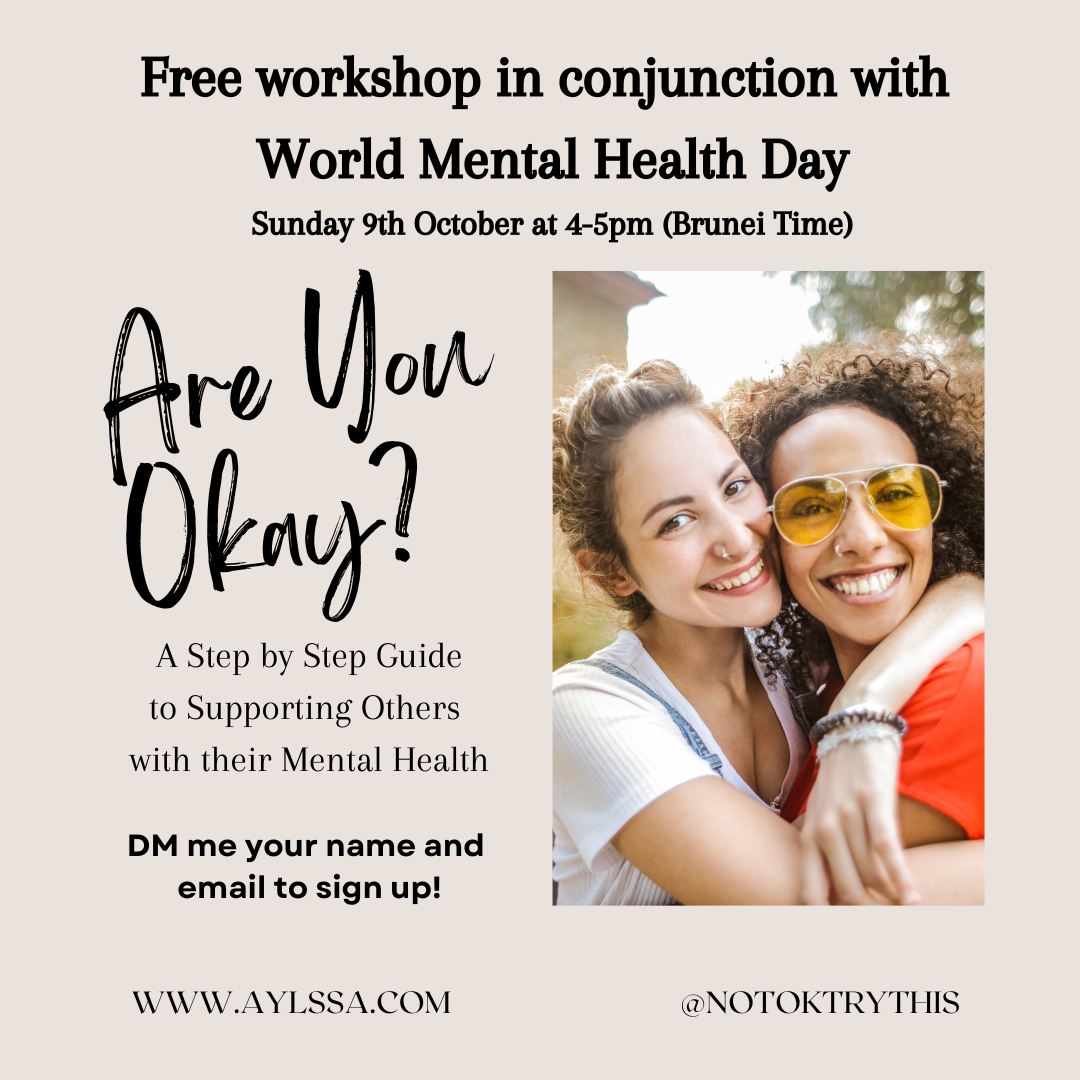
In conjunction with World Mental Health Day I am offering a free online workshop on Sunday 9th October at GMT+7 (4-5pm Brunei/Singapore/China, 3-4pm Thailand / Malaysia, or 9am in the UK). The workshop will focus on how to tell if someone you care for is not doing ok and what you can do to help.
To sign up please fill in your details below and I will send you the link
While a little bit of stress may be good for us to get working well, too much and we’re tipping into anxiety, panic then burnout. Too much stress and we lose motivation, it’s more difficult to concentrate and to remember things. Sometimes when we’re stressedout we keep jabbing at the thing we’re trying to do. We get frustrated and angry, and we can’t get anything done properly.
At this point you need to
STOP.
Breathe.
Go do something else for a time. Then come back to it. If it’s your life overall that is stressful, try to find some time in your day where you can do something mindful or fun. This helps reduce your stress levels, and allow your brain to start processing properly. When I tell students this they sometimes say
“I don’t have time!!!”
But you do. Because by taking time out here and there and giving your brain some recovery time. You’ll actually be able to think more clearly, work will become easier and you’ll increase your memory and concentration.
For example, did you know that just 1 hour of gardening each week has been shown to reduce anxiety? Just this small amount of time each week can have amazing benefits.
What mindful activities do you do to relieve stress?
A Third Culture Kid or TCK for short is a young person who has lived for a significant amount of time outside of their parents home country. Sometimes called Transnational Kids or Cross Cultural Kids, their personal identity will be different from both that of their parents and the cultures in which they live. They become a hybrid of the two; hence the term “third culture”.
There are approximately 600 million people worldwide who live outside of their birth country for various reasons; some families only live in countries for a set period of time (e.g. diplomatic staff, military families, those who work for some international corporations), others move out of necessity (displacement due to war etc) and others permanently migrate to another country.
The diagram above can help people understand how they are different and similar to both their parents and the wider culture. They can use the structure to figure out what aspects of their identity come from where, and what they also find difficult. For example some young people lose the ability to speak their parents home language so can find it difficult to converse with grandparents.
How about you? Are you a TCK? What have you found to be the difficulties and the strengths you’ve gained from living away from your parents passport country?
2 months into Covid19 and I’m finally hitting a wall. A wall that most people I think have already ran into by now. I am so over every conversation, every news piece, every way this has seeped into our psyches. My brain is finally fuzzy with an overload of cortisol and I feel like I’m wading through toffee to do the simplest of tasks. This is a normal physiological reaction to an overload of stress. I am grumpy and I am stressed. It’ll pass and I’ll pop out the other side, I’m sure, but in the meantime here’s some things that would really help me:
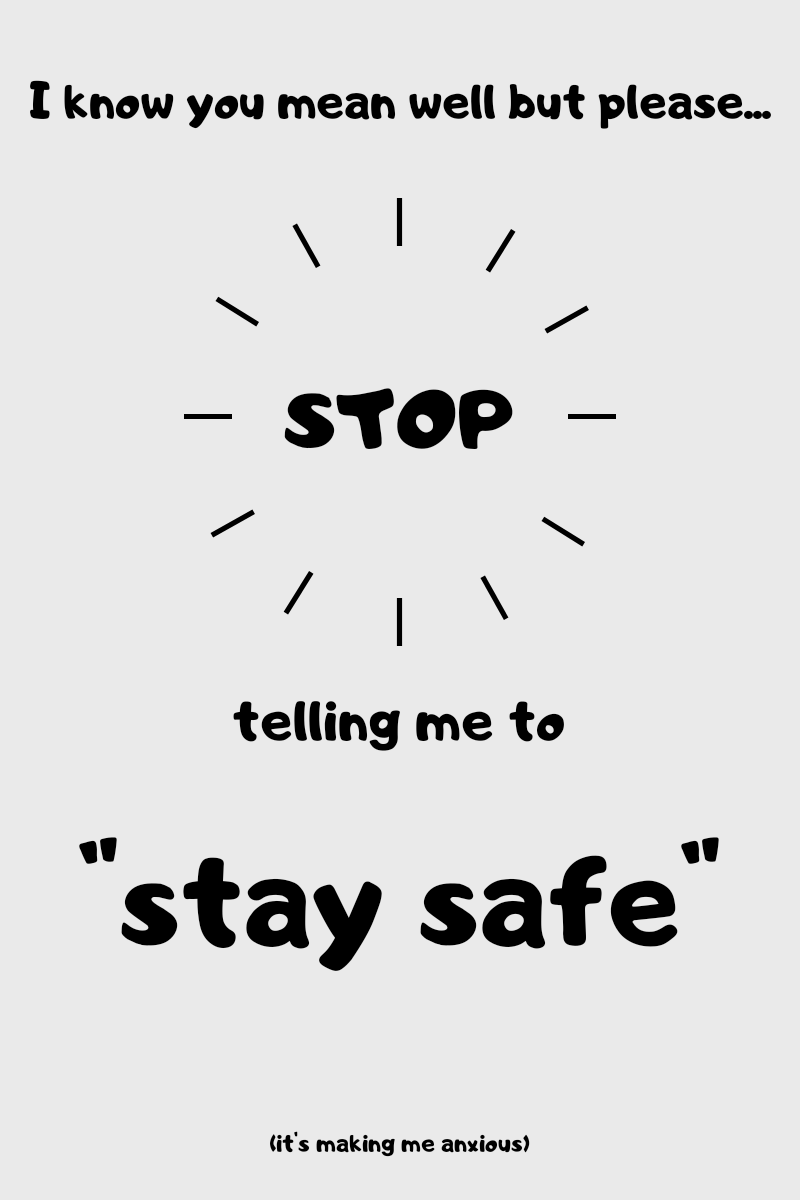
1. STOP telling me to “stay safe”
Safety is the bottom rung of Maslow’s Hierarchy of Needs. It is fundamental to our wellbeing. On a logical level I don’t feel unsafe right now. I’m doing the things that are asked of me and I’m generally healthy. But everytime someone tells me to “Stay safe” they are reminding me that I am unsafe – that I should be on the lookout for danger and that spikes my anxiety levels. And an overload of anxiety = not being able to think properly.
2. Please STOP telling me to [insert unsolicited safety advice in here]...
I’m not meaning Ministry of Health or WHO here. I’m talking about that bloke you know who is always reminding you to bleach your doorstep, that it’s all a global conspiracy or don’t buy stuff from China (which makes no sense and is tinged with more than a splattering of racism). Again I am doing all the stuff the MoH is asking of me. I am not putting myself in harms way as much as humanly possible given the threat is INVISIBLE! I don’t need reminding every five minutes that I should be feeling unsafe right now.
3. Please STOP adding my work email to your companies mass mailouts.
If I didn’t have contact with you before all this started what makes you think I care about how your company is dealing with Covid19? I don’t. And I don’t need you spamming me about a pandemic every couple of days.
I recognise the irony of writing a post asking people to stop talking to me about Covid19 and safety. And I also recognise that people need to talk about it to process what is happening. So take care of yourselves out there. Remember feeling like you’re wading through toffee is the new normal so take steps yourself to reduce those stress chemicals. This is what I need – what do you?







 Aylssa Temple