Sentence Starters are…

…great for getting people talking.

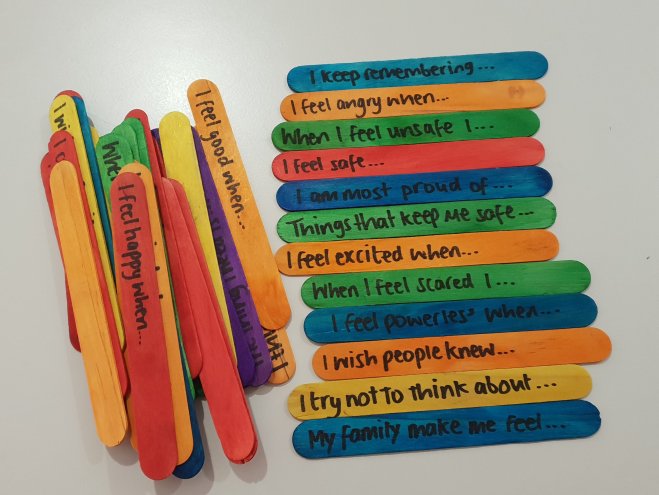
I bought these coloured lolly pop sticks a little while ago & finally got around to writing on them today. Each stick has the start of a sentence on it which the young people can finish.

Ideally they shouldn’t think too hard about what they answer. A way to do this could be to give them a sheet of paper & ask them to write down the first thing that comes into their head.

You could do a similar thing if you are into journaling and want random topics to write about. You could write things like – love, politics, family, religion, hope, tragedy, fulfilment etc on them and pull them out at random. You could colour coordinate them as well, so the yellow ones could be internal emotions say, the orange could be about relationships, blue about the world, green about self etc. The questions or topics you devise will depend on who is going to use them and for what purpose.

Mine will be used in counselling with young people so explore a range of emotions, wishes and coping strategies. What will you use yours for?

Navigating Tech and Relationships

I worry sometimes about young people and technology. No not for the reasons you might think of straight away. Not the sexting. Not the access to explicit content. Not the bullying. Not the myriad of horrendous people online. I’ve seen young people take down and deal with all of that spectacularly – its a world they’ve grown up in – most of the time that’s the easy stuff. No what I am worried about is the inability to turn off the tech from  friends and within romantic relationships.

When I was young – the very sentence makes me sound old – I went to school and saw my friends. I ‘played out’ – I saw my friends. I went home and over-analysed every minute detail of the day over the phone with my friends, until my mam or her mam screamed at us to get off the phone… the phonebill!! blah blah blah. Same with my boyfriend. I saw him for a couple of hours a day max. There was always a period of the day where we were alone or with my brothers, probably arguing about something someone had stolen off someone else.  I left my friends and my boyfriends behind physically, and often mentally. I just watched the TV, listened to music or, perhaps wrote out song lyrics which completely expressed my unrequited love (true story).

Whatever drama was going on, I got a break from it.

Now this is important. When we are worried about someone or something our stress chemicals flood our brain. We need time where we are distracted, doing something, anything, that helps reset this. If you walked into your house and your bathroom was flooded, what would be the first thing you’d do? Hopefully it would be to turn off the tap. Same with stress and anxiety. You need to be able to turn off the tap. In my job as a school counsellor I ‘prescribe’ fun activities as an antidote to stress. You need to be able to switch off.

Now I think this is where the problem lies. The tech has given young people access to each other 24 hours a day. When a friend leaves them ‘on read’ they get angry, or anxious that they’ve done something wrong. Moreover there is no getting away from each others drama. Or if someone is having a really tough time – of course as friends you want to support them. But where does it stop? I have heard stories of young people acting as mini-therapists to their friends until 3am, sacrificing their own health to help their friends. I know of young people – absolute heroes – that have talked other young people out of suicide in the early hours of the morning. The weight of this lies heavy on the shoulders of the helpers as anyone who works in the helping profession knows. But young people don’t have supervision. They don’t understand the meaning of self care and shutting off. And one by one they become more stressed and anxious, but unable to pin point why.

Then there’s romantic relationships. Leave me on facetime while you sleep. Connected all night. Expectations to be supported and to be there for each other 24 hours a day, 7 days a week. Expected instant replies. Expected password sharing. Expectations that were not there 20 years ago.

To young people I say this. You are absolute superstars and the support and help you give each other is tremendous. However you cannot drink from an empty cup as they say. Please, please, please consider setting some boundaries. Think about turning your internet off at 10pm. Get yourself some rest. Spend some time on you having fun. Get out into nature. Laugh. The world will  be there tomorrow. Self Care is not selfish, and anyone who tells you it is, is. Continue reading Navigating Tech and Relationships
Talking about consent & pleasure is essential to safeguard young people

In light of the renewed interest in the allegations against Michael Jackson, I thought I’d post this discussion from back in 2013 when I was interviewed for a Brook project on talking about sexual pleasure within Relationships and Sex Education. As Steve also says, children and young people who are sexually abused or exploited do not have the words to say, nor sometimes even understand what is happening for them. Comprehensive sex and relationships education for all is essential in this regard to safeguard young people from abuse.

72 Five Minute Stress Relief Ideas

  1. Cuddle your pet
  2. Do 20 star jumps
  3. Drink warm milo
  4. Walk around your house
  5. Smell your favourite perfume
  6. Stretch as high as you can
  7. Try to touch your toes
  8. Sing
  9. Dance to an upbeat song
  10. Be silly
  11. Look at a photo of a happy time
  12. Have a shower
  13. Have a snack
  14. Draw something simple & silly
  15. Go outside
  16. Listen to the birds
  17. BREATHE slowly & deeply
  18. Play an instrument
  19. Talk to a friend
  20. Scream
  21. Fake laugh for two minutes
  22. Laugh at something funny
  23. Watch baby animals on youtube*
  24. Moisturise your skin
  25. Wash your face
  26. Pray
  27. Talk to your siblings
  28. Do something nice for someone
  29. Send someone a text saying you appreciate them*
  30. Pretend you’re 5 years old
  31. Cry
  32. Shake your body
  33. Draw every noise you hear
  34. Listen to upbeat music and try not to move
  35. Skip
  36. Roll your shoulders and your head
  37. Write a list of all the things you are looking forward to
  38. Write a list of all the things you can do to relieve stress
  39. Change your clothes into something more comfy
  40. Watch a K-Pop video and try to copy the dance moves*
  41. Visualise your life after the thing causing you stress is over
  42. Write a letter to yourself
  43. Meditate
  44. Remind yourself about times you have gotten through stress before
  45. Take control of unhelpful thoughts – rationalise panic
  46. Tell yourself you can do this
  47. Organise your workspace*
  48. Try to think of a vegetable for every letter of the alphabet
  49. Do nothing*
  50. Write a poem
  51. Write down all your thoughts and worries
  52. Brush your hair
  53. Brush your pet
  54. Rock yourself gently
  55. Ask your parents/siblings for a hug
  56. Smell the flowers in your garden
  57. Take a break
  58. Write a list of your strengths (what would your best friend say about you)
  59. Do 20 sit ups / press ups
  60. Make a list of everything you have to do, PRIORITISE them and put together a schedule
  61. Try to balance on one leg
  62. Do a handstand against a wall
  63. Identify the source of stress & problem solve it if you can – ask is this worth stressing over?
  64. Make a song up as you go along about being stressed
  65. Write out motivational quotes*
  66. Make fun of this list
  67. Do some calligraphy
  68. Close your eyes and listen to your breathing – try to slow it down as much as possible
  69. Blow bubbles
  70. Blow up balloons & whack them around your bedroom
  71. Lie on the floor and tense then relax all your muscles
  72. Ask for help…

*has the potential to send you into a procrastination spiral so stay away from if you cannot trust yourself.

Originally written for The Wallflower Project.

A Letter to the Stayers

It’s that time of year again. Students with signatures all over crisp white school shirts. One day they are here; the next there’s an empty seat where your friend used to be. And this happens over and over again, until one day you may decide that what’s the point in making new friends – it’s only emotional investment to be ripped away. And it can be hard, so, so hard to see your group, once so close scattered across the globe. Instagram photos of new friends, of new adventures, of new lives, while you wander lost around the school, trying to figure out now where you fit amongst the cliques left behind. How do you approach those acquaintances, that person in your English class, or the others left here in limbo? Maybe you won’t bother. Maybe you will decide that hiding out in classrooms to ‘finish your coursework’ is a better choice. Maybe head down, headphones on in the ELC is a better bet. At least your grades will go up you think to yourself. But you are lonely.

So here it is. We don’t really talk about the emotional hardship, of the loss felt by those who stay. We know it is hard for those who leave. But for those who stay some of you will have lost 4, 5, 6, 7… countless people who were close to you. The school is the same but it’s not really the same. Pretending you don’t care is a coping strategy – creating arguments before they leave so it is easier to say goodbye only makes the pain worse. Tell them you love them. Tell them what they mean to you.

Remember there are others in school who feel the same; others that have had friends leave and may also need a connection. Think about the type of friendship you need (big group? 1 close friend?) Join a random CCA that you’re interested in (rather than what would “look good”). Say hello to the other people hiding out in the studyhall, the classrooms, the library. Think about what makes you happy and do more of that. Ask if you can sit in the canteen with friendly faces. Talk about school work if you don’t know what to say. Allow yourself to feel sad. If you feel overwhelmed speak to someone, a teacher, a tutor a counsellor.

Look out for each other out there– if you are lucky enough to have your friends stay – look out for those who don’t.  Invite them to sit with you. Say hello in the corridors. Ask them if they are okay. Our words are powerful and you should never underestimate the impact of a small gesture.

This post was originally written for and posted on The Wallflower Project.

Making a calm down glitter jar

Today I’ve been making calm down glitter jars with some of my students. These are great for anxiety because mindfully watching the swirls of glitter can help bring you back into the present moment. Anxiety lives in the past or the future. People generally worry about things that have happened or things that are going to happen. This little jar can help stop those thoughts, even just for a couple of minutes.
What do I need?

  1. a water-tight jar
  2. Clear multi-purpose glue (liquid)
  3. Hot water
  4. Food colouring
  5. Glitter

and if you are anything like me, paper to scoop up any spilled glitter!


How do I make one?

  1. Fill your jar to around 80% with hot water (I use it straight out of our water dispenser so its pretty near boiling – it has to be hot enough to melt the glue)
  2. Add a touch of food colouring – the more you add the darker it becomes. As this forms your overall colour make sure you are happy with it.
  3. Add glitter. There needs to be enough to swirl around but don’t overload it at this point – you can add more later if needed.
  4. Stir in the glue to fill the rest of the jar. Keep stirring until the glue has dissolved into the water.
  5. Put the top on (ensure it is secure) then tip and shake it gently. If the glitter falls to the bottom of the jar too quickly you need more glue. Add extra glitter if you need to.
  6. Leave to cool.
  7. Optional: super glue the lid on if you are giving this to younger children as I can imagine them tipping it out all over your carpet won’t be much fun.

Ideas for its use

  • Shake and watch the patterns as the glitter moves around
  • Count the number of glitter flecks you can see
  • How many colours of glitter can you see in the jar
  • Watch how the glitter floats and hangs in the air, imagine yourself doing the same
  • Shake the jar and breathe slowly and deeply while watching the glitter slowly fall to the bottom

Here’s a video if you need it:

How to make a Glitter Jar